
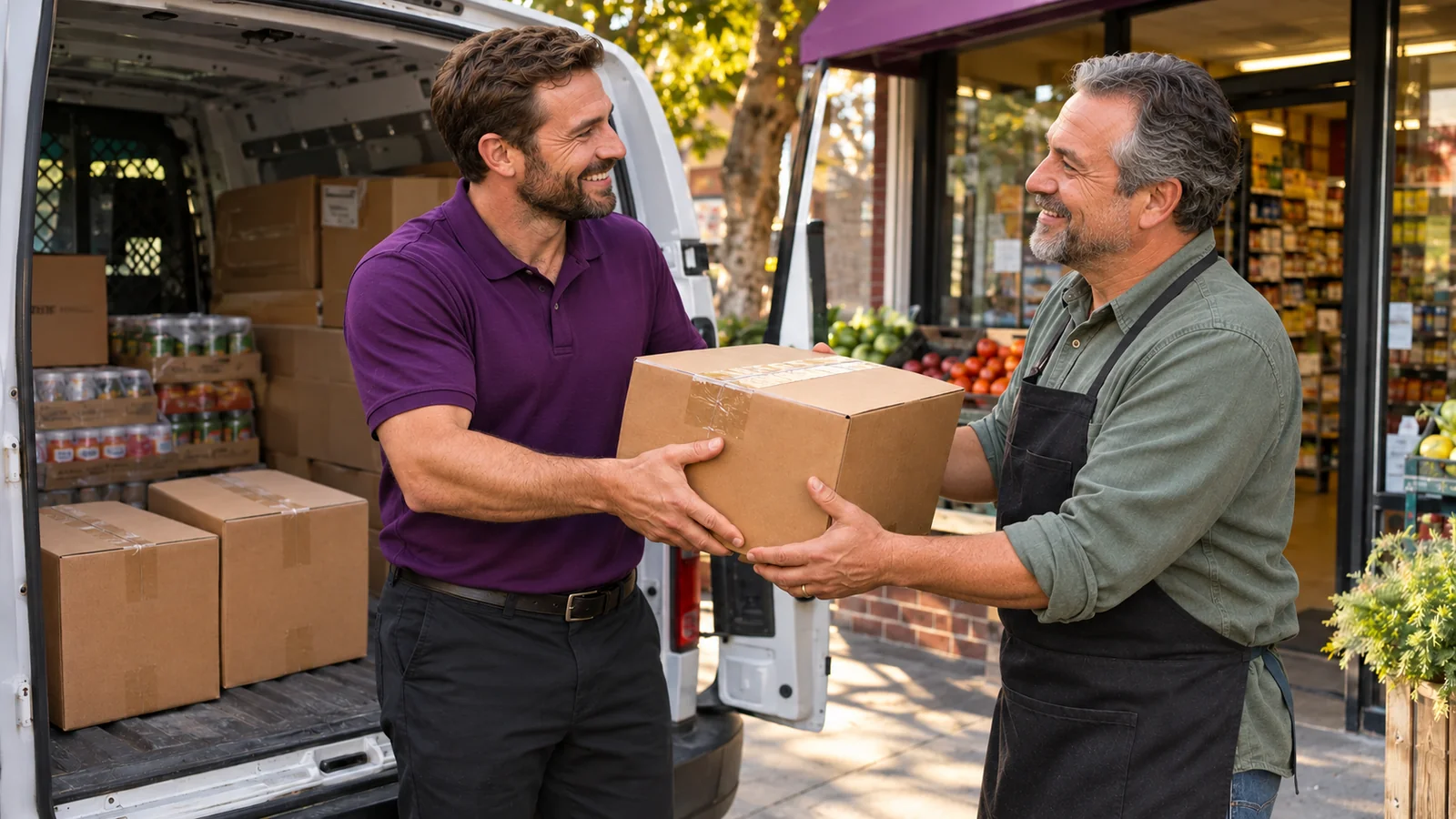
A customer orders on Monday for a Tuesday delivery. On Tuesday, a rush leaves them out of stock. They need three more cases than they ordered.
Our pre-sales process could not supply those extra cases. Another distributor filled the gap, got a foot in the door, and eventually took the account.
That happened more than once in my distribution business. We also saw the opposite: being able to respond at the stop helped us retain customers and sell more.
That experience shapes my answer to van sales vs. pre-sales. For a small distributor serving stores with changing demand, I generally favor van sales. Speed and flexibility can give a small operation a reason to win the business.
Van sales makes more money when the gross profit from additional sales and any operating savings exceeds the extra selling time, mileage, and inventory costs. Pre-sales can be more profitable when predictable orders let you deliver more efficiently, use limited truck space well, or reduce costly stock exposure.
Here is how I would evaluate the choice for a U.S. distributor running roughly one to seven routes.
I’m Jared, the founder of Marmot Systems. The customer and correction-delay examples below come from my experience running a distribution business. The financial example is illustrative; its numbers are not results from my business or Marmot customers. Marmot supports both van-sales and pre-sales workflows.
What is the difference between van sales and pre-sales?
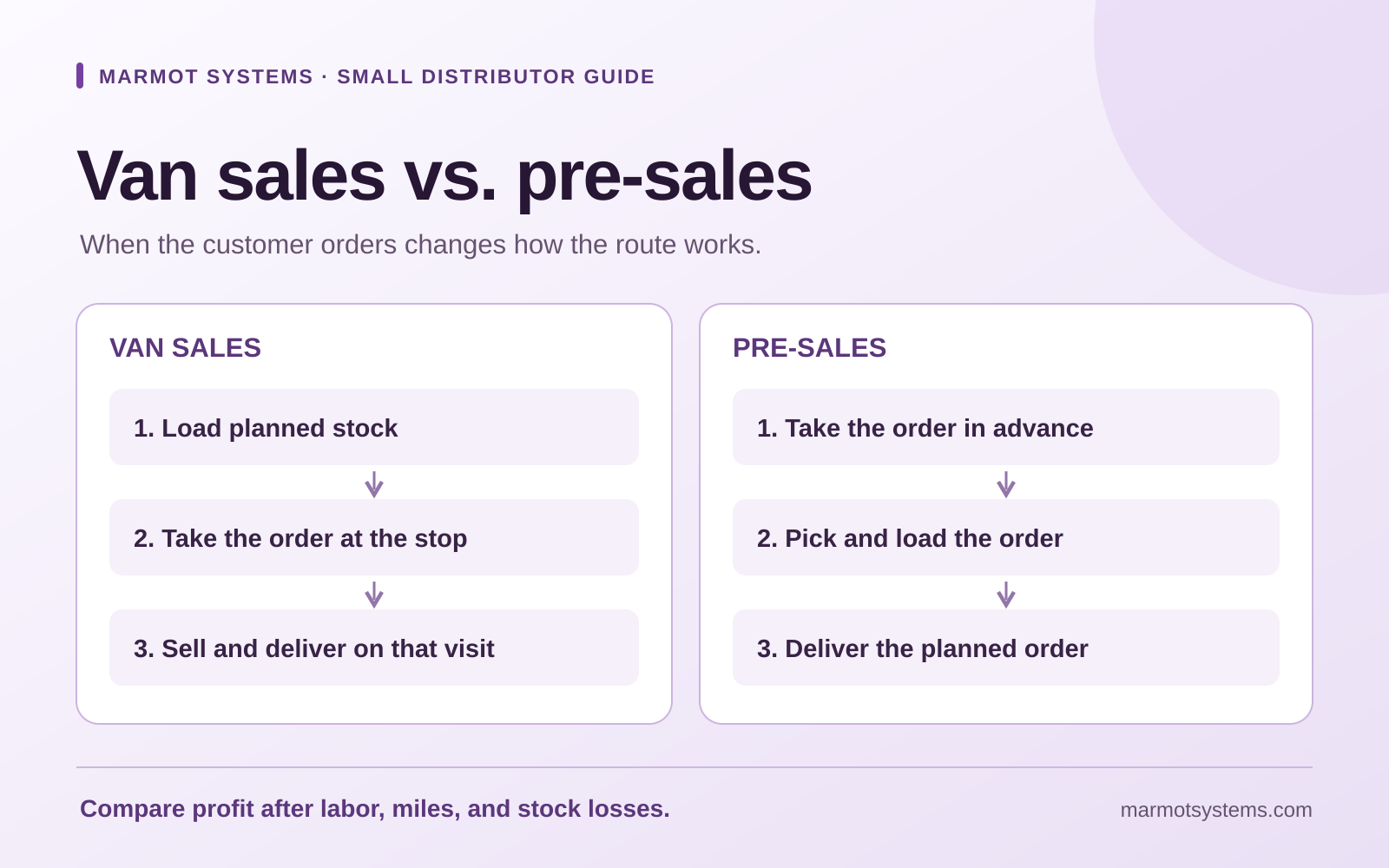
Van sales means carrying stock on the vehicle, taking the customer's order at the stop, and supplying the products during that visit. The driver or route salesperson can invoice the sale and record payment as appropriate. The vehicle can be a van or a truck; the selling model is what matters. Example van-sales workflow
Pre-sales means taking the order before delivery. The warehouse can pick and load against that order, and a driver delivers it later. The order might come from a salesperson's visit, a customer calling the office, or online ordering. A separate physical sales visit is one possibility, not a requirement. Example order-to-delivery workflow
Both can be part of direct store delivery. The key difference is when the customer decides what to buy relative to loading and delivery.
| Decision | Van sales | Pre-sales |
|---|---|---|
| What goes on the truck? | An assortment based on expected demand and available capacity | Known orders, potentially with a planned buffer for extras |
| Can the customer buy more at the stop? | Yes, if the right stock is available and the driver can sell it | An exact-order load can limit extras; a suitable hybrid can accommodate them |
| Where does selling time occur? | During the route visit | Before delivery, through a rep, phone, or online order |
| What can make the stop faster? | Resolving the sale and paperwork locally | Delivering a prepared order with fewer decisions at the stop |
| Where can stockouts arise? | The loaded assortment or quantities do not match actual demand | The original order misses a later need, or ordered goods are unavailable |
| What can constrain growth? | Longer selling stops, limited truck space, unsold stock, or scattered trips | Order-taking costs, restrictive changes, or missed additional sales |
Neither model automatically creates a short route, a full truck, or a profitable customer. Those outcomes depend on how you operate it.
Why I favor van sales for small distributors
A customer's needs can change after the order is placed
The three-case example was not just about the revenue on three cases. A customer needed help immediately, and our process could not respond. A competitor then had an opportunity to prove that it could.
That is a practical way a small distributor can compete: carry an appropriate assortment, understand the customer's store, and respond to what is needed during the visit.
Van sales can help a driver capture that demand when the goods are already on the truck. It can also make it easier to introduce a suitable additional product or adjust an order to what the store actually needs.
The qualification matters: the right product has to be available. Carrying extra stock does not help if it is the wrong assortment, already committed to another customer, or too costly to keep on the truck.
Invoice corrections should not consume the route
In our previous process, a customer might want a smaller quantity or notice that an agreed price was wrong. The driver would wait at the customer's store while our office corrected the invoice.
Those waits could take 30 minutes to an hour. Sometimes an administrator had left or was unavailable, and the driver had to come back another day.
That time affected more than one stop. It delayed the rest of the route and could create another trip for work that should have been resolved during the original visit.
A direct-sales workflow that lets an authorized driver prepare the right quantities and prices before finalizing the sale can reduce that dependence on the office.
However, office correction delays are a process and software issue, not an unavoidable feature of pre-sales. Some systems combine assigned deliveries, sales from spare truck stock, and orders for later fulfillment. Evaluate the actual correction and additional-sale workflow during a demo. Example of combined delivery and van-sales workflows
Flexibility can protect the customer relationship
In my experience, small distributors benefit when they can say, “Yes, we can help with that today.” That may mean supplying additional cases, accepting a smaller order, or resolving a pricing question without leaving the customer waiting.
This does not mean approving every discount or making every emergency delivery. A sale still needs an acceptable margin, and a special trip still has a cost. Flexibility works best with clear limits on pricing, stock, and service commitments.
When pre-sales can make more money
Pre-sales has a strong case when knowing the order in advance improves the economics of the operation:
- Large, predictable orders. A prepared delivery can spend less time selling at the stop and leave more time for other customers.
- Limited truck capacity. Known orders can help prioritize space for goods already requested. Spare stock has a cost if it displaces a profitable confirmed order.
- A wide catalog or short product life. It may be impractical to carry enough of every product. Advance ordering can help match the load to demand, although it does not eliminate shortages or spoilage.
- Customers with structured receiving requirements. Agreed orders, receiving windows, and purchasing approvals can make a planned delivery the better service model.
- Low-cost order capture. Customers who reliably call or order online may need little separate selling time. That is a different cost structure from sending a rep ahead of every delivery.
There are two different kinds of speed here. Van sales can respond faster to a changed need. Pre-sales can make a known delivery faster. The better choice depends on which one creates more value for your customers and your route.
A worked profit example: when $300 more in sales leaves $36
Here is a deliberately simple, illustrative example. These are assumed numbers chosen to explain the calculation, not industry averages or measured customer results.
Compare the same set of stops over one route day. Assume both models complete the existing sales. Van sales adds $300 in genuinely additional sales, after discounts and excluding sales tax, at a 30% gross margin.
Assume those extra sales extend paid driver time by one hour, add 20 vehicle miles, and increase expected stock losses. Other order-taking, warehouse, administration, and fixed costs are unchanged in this example.
| Change from the pre-sales baseline | Calculation | Effect on contribution |
|---|---|---|
| Additional sales | $300 | Revenue, before product cost |
| Additional gross profit | $300 × 30% margin | +$90 |
| Additional driver time | 1 hour × $24, including employment costs | −$24 |
| Additional vehicle expense | 20 miles × $0.75 assumed operating cost per mile | −$15 |
| Additional spoilage or shrink, at cost | Assumed net loss after recoveries | −$15 |
| Additional operating contribution | $90 − $24 − $15 − $15 | +$36 |
The $0.75 mileage figure is an assumption for this example, not a tax mileage rate or an industry benchmark. Replace it with your relevant vehicle costs, and do not also subtract the same fuel or maintenance a second time.
The extra sales produce $90 of gross profit, not $300 of profit. After $54 of additional operating costs, $36 remains to contribute to the business. This is the change in contribution under the stated assumptions, not the company's total net profit.
How much extra selling is needed to break even?
Required additional sales = additional operating costs ÷ gross margin.
For this example: $54 ÷ 0.30 = $180 in additional sales.
At $300, van sales adds $36. At only $100 of extra sales, the same costs create a $24 reduction in contribution: $30 in additional gross profit minus $54 in costs.
If switching also removes a real sales visit or reduces correction work, include the resulting savings. If customers already call in their orders, do not invent a salesperson's salary saving. If a salaried employee simply has more free time, distinguish the extra capacity from a reduction in cash expense.
Also check whether an apparent extra sale merely brings forward next week's order. Evaluate several comparable weeks, including returns and changed purchasing patterns, before treating it as additional demand.
Van sales needs disciplined route planning
Van sales loses some of its advantage when flexibility turns into repeated, unplanned trips across the same territory.
My advice is to plan where you will be throughout the week, not just which customer you will visit next. Group nearby accounts where their buying patterns and receiving schedules allow it.
Some customers legitimately need multiple visits each week. The goal is to make those visits deliberate and worthwhile, while limiting avoidable backtracking and low-value emergency runs.
For each route, track:
- Gross profit from sales, including the margin on added products.
- Driver hours and time spent waiting for corrections.
- Miles driven and the reason for additional trips.
- Stockouts, unsold stock, and actual spoilage or shrink.
- Missed stops or confirmed sales displaced by extra selling time or truck stock.
Unsold stock that can still be sold is not automatically a loss. It does tie up cash and can create handling, storage, or eventual markdown costs. Keep those effects separate from the cost of products already included in gross profit.
A hybrid can preserve both predictability and flexibility
You do not have to give every account the same workflow.
A distributor can take advance orders for predictable, larger customers and use van sales for stores with more variable needs. Another option is to load confirmed orders plus a measured buffer of likely extras, where the vehicle, product life, and software support that approach.
Protect committed orders first. Extra selling should use stock genuinely available for that purpose. Otherwise, solving one customer's shortage can create another customer's shortage later in the route.
Start with a small group of accounts and measure the effect. Compare similar weeks, account for promotions or seasonal demand, and look at contribution and customer service together.
How Marmot supports the choice
Marmot supports direct sales, pre-sales, and delivery-only workflows, configured for each driver. That lets a small distributor choose the operating model that fits each part of its business.
For van sales, the direct-sales workflow is designed around preparing the sale at the stop:
- Select products and adjust quantities while building the invoice.
- Use customer pricing and edit line prices when the driver's pricing controls allow it.
- Create invoices and record payments with offline Android field work.
- Print invoices on supported mobile printers and review synchronized activity in the office.
That flexibility applies while preparing a direct sale. Assigned deliveries retain their planned product and price rules; they are a different workflow. A useful demo should show your actual order changes and additional-sale scenarios.
Our Barahona Foods customer story describes a move from mainly pre-sales and paper-based selling to direct sales with Marmot, giving drivers more flexibility during the store visit. The reported improvement is qualitative; it is not a measured profit comparison between the two models.
Frequently asked questions
Is van sales always more profitable than pre-sales?
No. It can generate more sales, but extra labor, miles, stock losses, or displaced deliveries can consume the additional gross profit. Use the actual margin and costs for your routes.
Does pre-sales always require two store visits?
No. A salesperson may visit before delivery, but customers can also call or order online. Include the order-taking work your business actually performs.
Can a pre-sales route accept additional orders?
Potentially. It needs available stock, the right permissions, and a workflow that supports the additional sale. An exact-order load without spare stock is more restrictive. Confirm the handling of changes and extras in your software.
Which model would I choose for a small distributor?
For the kind of small distribution business I ran, I would start by evaluating van sales because customer needs changed and the ability to respond helped us compete. I would keep pre-sales where larger planned orders, customer requirements, truck capacity, or product handling made it the better choice.
See the workflow with your own routes
Bring us one normal order and one that changes at the stop. We can show how Marmot handles the relevant direct-sales or pre-sales workflow, pricing controls, paperwork, and stock tracking.
Book a Marmot demo, review supported printers and devices, or compare the options in our DSD software guide for small distributors.